There's a certain rhythm to Bangkok that first-time visitors often miss. They rush from golden temples to floating markets, from rooftop bars to night bazaars, ticking boxes on their itineraries while the city's true heartbeat pulses just beneath the surface. I've watched countless travelers return from Thailand's capital with photographs of the Reclining Buddha and stories of tuk-tuk rides, yet somehow having entirely missed what makes this city extraordinary.
If you ask ten seasoned Bangkok travelers for their single must-do activity, you'll likely get ten different answers. Some will swear by the street food tours through Chinatown, others by the early morning alms-giving to monks, and still others by the hidden cocktail bars down unmarked alleys. But after living in this city for years and watching visitors come and go, I've observed one experience that consistently transforms how people perceive Bangkok - an experience so fundamental that it rewires your understanding of Thai culture.
What I'm about to suggest won't appear in most guidebooks, and it certainly doesn't make for dramatic Instagram content. But trust me when I say this: The one thing you absolutely must do in Bangkok is spend an entire day saying "yes" to every unexpected invitation and spontaneous opportunity that comes your way.
This might sound simple, even trivial. But in practice, it requires surrendering the very travel instincts we've been taught to cultivate - the careful planning, the safety-first approach, the structured sightseeing. Bangkok reveals its magic not through checklist tourism but through what Thais call "sanuk" - the pursuit of joy in the everyday. And sanuk rarely appears on schedule.
Let me give you an example from just last week. A friend visiting from London had meticulously planned her four days in Bangkok. On her second morning, while waiting for the BTS Skytrain, she struck up a conversation with an elderly Thai woman who turned out to be heading to a temple ceremony for her granddaughter's graduation. My friend, remembering my advice, accepted the woman's invitation to join them.
What followed was eight hours completely off-script. She participated in a Buddhist blessing ceremony, helped prepare food for the monks, learned to make traditional floral arrangements from the grandmother's friends, and ended the day at a family celebration where she was treated not as a tourist but as an honored guest. She missed her scheduled visit to the Grand Palace but gained something far more valuable - genuine connection.
This is the Bangkok that exists parallel to the tourist trail - a city of spontaneous generosity and unexpected friendships. The challenge for most visitors is that they're so focused on seeing the sights that they don't notice the invitations when they appear.
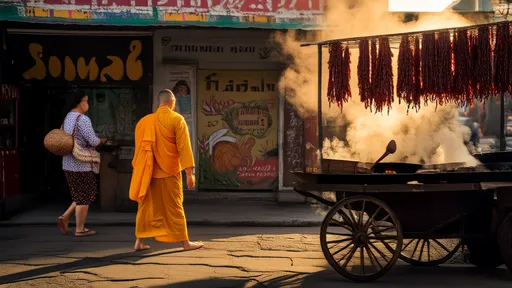
You'll know these moments when they happen. The street food vendor who gestures for you to sit on the tiny plastic stool beside them rather than taking your food to go. The shopkeeper who offers you tea and starts asking about your family. The stranger who sees you looking lost and not only gives directions but walks with you to your destination. These aren't sales tactics or hidden agendas - they're genuine expressions of Thai hospitality.
I understand the hesitation. We've been conditioned to view strangers with suspicion, to stick to our plans, to avoid the unknown. But Bangkok operates on different social codes. The Thai concept of "kreng jai" - consideration for others' feelings - means that people generally extend invitations only when they're genuinely willing to include you.
My own most memorable Bangkok experiences have all come from saying "yes" when logic said "no." The time I accepted a motorcycle taxi driver's invitation to join his family for dinner in their simple home near the khlongs. The afternoon I abandoned my shopping plans to help a group of university students practice their English presentation. The evening I joined a group of office workers at their regular street food spot instead of dining at the fancy restaurant I'd booked.
Each of these experiences taught me more about Thai culture than any museum or guided tour ever could. I learned about family dynamics, workplace hierarchies, spiritual beliefs, and the subtle humor that defines Thai communication. More importantly, I learned that the greatest luxury travel offers isn't five-star hotels or exclusive access - it's genuine human connection across cultural divides.
Now, I'm not suggesting you throw caution entirely to the wind. Use common sense - don't follow anyone to isolated areas, keep your valuables secure, and trust your instincts if something feels wrong. But within reasonable boundaries, practice radical openness.
Start your "yes" day early. When the hotel staff suggests a local breakfast spot instead of the hotel buffet, go. When a tuk-tuk driver offers to show you "the real Bangkok" for a few hours, negotiate a fair price and hop in. When a market vendor invites you to try a fruit you've never seen, accept with a "kop khun krap" and ask how to eat it properly.
You'll notice something interesting happens when you approach the city with this mindset. The infamous Bangkok traffic becomes less frustrating when you're not racing to your next appointment. The heat becomes more bearable when you're not marching between sights. The language barrier becomes less intimidating when you're communicating through gestures and smiles.
What you're doing, essentially, is trading the role of observer for that of participant. Instead of looking at Thai culture from the outside, you're allowing yourself to be temporarily woven into its fabric. This is where travel transforms from vacation to education, from escape to enrichment.
The beauty of this approach is that it costs nothing extra. You don't need to book a special tour or pay for exclusive access. You simply need to shift your mindset from defensive to receptive, from scheduled to spontaneous.
I've seen hardened business travelers soften when embraced by a local family's celebration. I've watched anxious tourists shed their guardedness when included in a street food vendor's daily routine. I've observed language barriers dissolve in shared laughter over mispronounced Thai words.
This approach works because Bangkok, despite its size and chaos, remains fundamentally a city of villages. Beneath the skyscrapers and shopping malls are tight-knit communities where people still look out for one another, where strangers are often treated as friends who haven't yet introduced themselves.
Your "yes" day might include helping a grandmother carry her groceries to the boat pier. It might involve joining an impromptu badminton game in a neighborhood alley. It could mean accepting an invitation to a co-worker's birthday party from someone you just met at a coffee shop.
The specific activities matter less than the mindset. The goal isn't to collect experiences like souvenirs but to let Bangkok change you, however slightly. To leave with not just photographs but with expanded understanding. To return home not just with stories but with perspective.
This is why, after all my years here and countless visitors hosted, I remain convinced that the single most important thing you can do in Bangkok has nothing to do with any specific location or activity. It has everything to do with how you approach the city and its people.
So when you visit Bangkok, by all means see the temples and palaces. Enjoy the shopping and massages. But save one day - just one - for saying "yes." Leave your itinerary blank and your schedule open. Wake up with no plan beyond being present and receptive.
You might end up in places you never expected to see, talking with people you never imagined meeting, doing things that never appeared on your bucket list. And when you return home, it's these unplanned moments you'll remember most vividly - the time Bangkok welcomed you not as a tourist but as a temporary local, the day you discovered that the city's greatest treasures aren't its sights but its people.
Trust me on this. The Grand Palace will still be there on your next visit. But the opportunity to be spontaneously included in the life of this magnificent city? That's a gift available only to those brave enough to say "yes."
By James Moore/Nov 10, 2025
By Samuel Cooper/Nov 10, 2025
By Daniel Scott/Nov 10, 2025
By Elizabeth Taylor/Nov 10, 2025
By William Miller/Nov 10, 2025
By Joshua Howard/Nov 10, 2025
By Joshua Howard/Nov 10, 2025
By Benjamin Evans/Nov 10, 2025

By Daniel Scott/Nov 10, 2025
By Lily Simpson/Nov 10, 2025
By Sophia Lewis/Nov 10, 2025
By Elizabeth Taylor/Nov 10, 2025
By Daniel Scott/Nov 10, 2025
By Emily Johnson/Nov 10, 2025
By Olivia Reed/Nov 10, 2025

By Thomas Roberts/Nov 10, 2025
By Megan Clark/Nov 10, 2025

By John Smith/Nov 10, 2025
By Olivia Reed/Nov 10, 2025
By Ryan Martin/Nov 10, 2025
