I leaned against the weathered wooden railing of the long-tail boat, the salt spray a fine mist on my skin. The Thai guide, a man named Somchai with a face etched by sun and sea, had promised something special. We had left the cacophony of Phuket's Patong Beach far behind, the roar of jet skis and the thrum of tourist crowds fading into a memory. For over an hour, we sliced through turquoise waters, passing limestone karsts that rose from the sea like ancient, moss-covered sentinels. The journey itself felt like a shedding of skin, a deliberate departure from the Thailand I thought I knew.
My quest had begun weeks earlier, fueled by a deep-seated weariness of curated travel experiences. I was tired of beaches where the sand was polished by a million flip-flops and the only authentic thing was the price of a cold Singha beer. I wanted emptiness. I wanted silence broken only by the waves. I wanted a stretch of sand that felt discovered, not delivered. This wasn't about luxury; it was about authenticity. It was about finding a place that still belonged to itself.
The key, I quickly learned, was to abandon the well-trodden path. The eastern islands like Koh Samui and Phangan, while beautiful, are firmly on the backpacker and party circuits. The western hubs like Phuket and Krabi are magnificent, but their main beaches are grand central stations of tourism. My research, a deep dive into obscure travel forums and conversations with expats in Bangkok, pointed me south. Not to the famous Similan Islands, which are protected and accessible primarily via day-trip tours, but to the Trang Archipelago and the lesser-known reaches of Krabi province, away from the Railay behemoth.
This is where Somchai came in. Finding him was the first victory. He wasn't listed on any major tour aggregator site. He was a recommendation from a friend of a friend, a local fisherman who supplemented his income by taking small, private groups out on his personally crafted long-tail boat. His English was functional, woven with a calm, patient demeanor. When I explained my mission—no tourists, no vendors, just a beach—he simply nodded, a slow, knowing smile spreading across his face. "I know a place," he said. "It is not easy. But it is real."
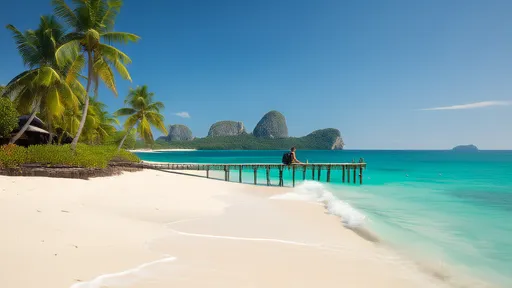
The boat finally began to slow, its puttering engine dropping to a gentle murmur. We rounded one final karst, and there it was. It wasn't a wide, sweeping bay fit for a postcard. It was a crescent of pristine, white sand nestled between two thickly jungled headlands. The water was a translucent aquamarine, so clear I could see small schools of iridescent fish darting over the seabed from the boat. Most importantly, it was empty. Utterly, profoundly empty. There were no sun loungers, no umbrellas, no bars blaring Bob Marley. There was only the sand, the jungle, and the sea.
Wading ashore, the fine powder-like sand squeaked under my feet. The silence was a physical presence, a blanket of calm broken only by the gentle lapping of waves and the distant cry of a sea eagle. I walked the entire length of the beach, maybe three hundred meters, and found not a single piece of litter, not a single footprint other than my own. The jungle behind the beach was impenetrably green and alive with the chatter of unseen monkeys and the trill of exotic birds. This wasn't a resort's manicured backdrop; this was a raw, untamed wilderness meeting the ocean.
I spent the day in a state of blissful solitude. The water was bath-warm and incredibly buoyant. Floating on my back, staring up at the vast, cloud-dappled sky, I felt a million miles from everything. This was the antithesis of a crowded tourist beach. There was no performance here, no need to see or be seen. It was a place for introspection, for simply being. Somchai had packed a simple lunch of grilled fish, sticky rice, and fresh mango, which we ate in the shade of a gnarled pine tree that leaned precariously over the sand. The fish, he told me, he had caught that morning.
The logistics of finding such a place are deliberately obscure. There are no signs pointing the way. You cannot book a ticket. Its existence relies on the knowledge of local boatmen like Somchai and a willingness to venture into areas without infrastructure. We departed as the sun began its descent, painting the sky in hues of orange and purple. As the boat pulled away, I watched the beach recede, a perfect, untouched crescent returning to its solitude. There were no other boats arriving, no one to take our place. It felt less like leaving a location and more like waking from a beautiful, vivid dream.
This experience taught me that the perfect, tourist-free beach is not a pin on a map. It is a concept. It requires effort, a rejection of convenience, and a deep respect for the local environment and culture. It means seeking out the small-scale operators, the fishermen, the family-run guesthouses. It means being flexible, patient, and embracing the journey as much as the destination. The Thailand of crowded tours and souvenir stalls is real, but it is only one layer. Beneath it lies another country, one of hidden coves, quiet dignity, and breathtaking, solitary beauty. My perfect beach was not a place I found, but a place that found me, precisely because I was willing to look in the spaces between the dots on the tourist map.

By James Moore/Nov 10, 2025
By Samuel Cooper/Nov 10, 2025
By Daniel Scott/Nov 10, 2025

By Elizabeth Taylor/Nov 10, 2025
By William Miller/Nov 10, 2025
By Joshua Howard/Nov 10, 2025
By Joshua Howard/Nov 10, 2025
By Benjamin Evans/Nov 10, 2025
By Daniel Scott/Nov 10, 2025
By Lily Simpson/Nov 10, 2025
By Sophia Lewis/Nov 10, 2025
By Elizabeth Taylor/Nov 10, 2025
By Daniel Scott/Nov 10, 2025
By Emily Johnson/Nov 10, 2025
By Olivia Reed/Nov 10, 2025
By Thomas Roberts/Nov 10, 2025
By Megan Clark/Nov 10, 2025
By John Smith/Nov 10, 2025
By Olivia Reed/Nov 10, 2025
By Ryan Martin/Nov 10, 2025
